
Find spells, rituals, herbs, symbols, and hidden connections
The Knowledge Explorer allows you to search far beyond a traditional spell database.
Instead of browsing isolated pages, you can explore how rituals, ingredients, goals, traditions, and magical concepts are connected across the archive.
Whether you are looking for a protection spell, a money ritual, a specific herb, or simply exploring magical traditions, the Explorer helps you discover related knowledge that would normally remain hidden inside books.
Start with a search
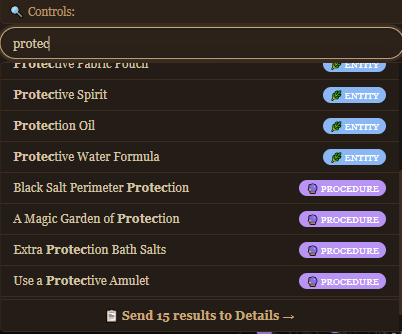
Use the search box to look for:
- a spell or ritual;
- an herb, stone, candle color, or other ingredient;
- a magical goal such as protection, love, prosperity, or cleansing;
- a tradition;
- an author;
- a book or source.
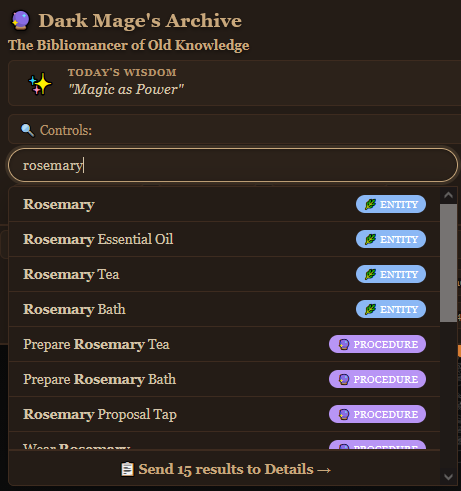
For example, searching for Rosemary immediately shows the Rosemary node and its connections throughout the archive.
Open the Details panel
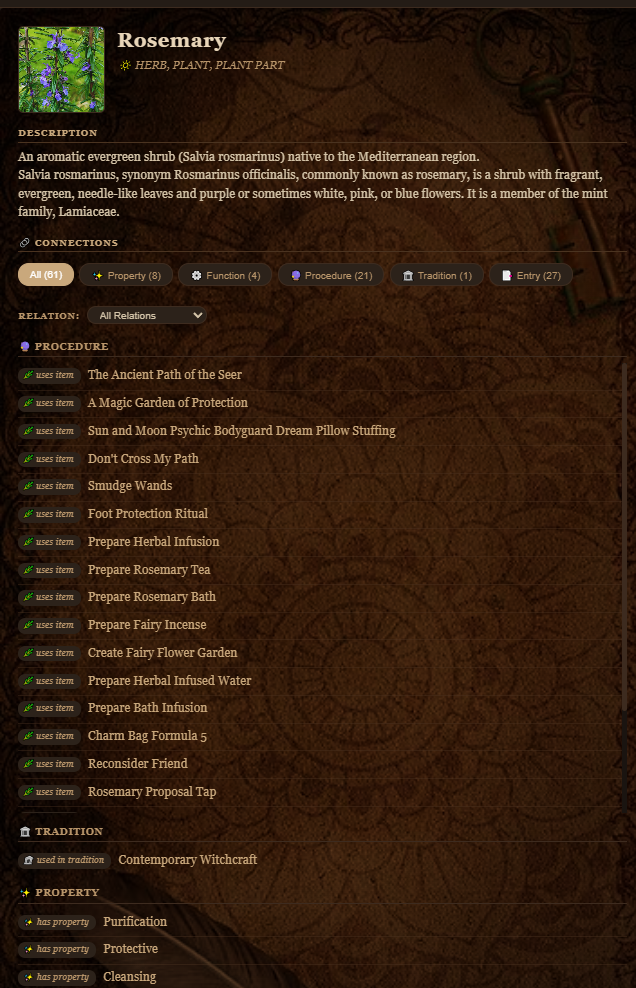
When you click a node in the graph, the Details panel opens.
This panel contains much more information than the graph itself.
Scroll down inside the Details panel to explore all available sections.
Explore connected knowledge
Near the bottom of the Details panel you will find the list of connected entities.
These connections can be displayed in List or Tree view.
Use them to jump directly to related knowledge.
For example, from an herb you can discover:
- rituals that use it;
- spells that include it;
- magical functions associated with it;
- goals it helps achieve;
- other ingredients that appear in similar procedures.
Find similar rituals and spells
One of the most powerful features of the Explorer is discovering similar procedures.
A ritual connected to Protection may lead you to many other protection rituals from different traditions and sources.
This allows you to compare methods, ingredients, and symbolic patterns across multiple books.
Discover where an item is used
If you open an item such as Rosemary, Hyssop, Salt, or Black Candle, the Explorer shows every documented place where that item appears.
This is often much more useful than reading a single recipe because it reveals how the same ingredient is used for different purposes across different traditions.
Follow the path of a concept
You are not limited to a single search.
A typical exploration might look like this:
Protection → Ritual → Rosemary → Purification → Hyssop → Cleansing Rituals
Each step reveals another layer of related knowledge.
Use the graph for exploration
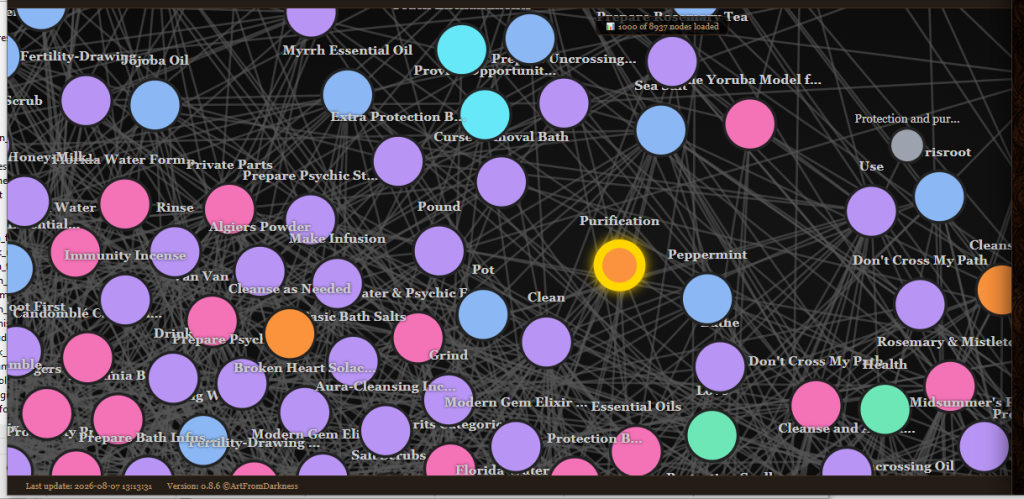
The graph is designed for curiosity.
You do not need to understand every connection immediately.
Simply follow the nodes that seem interesting.
Many users begin by searching for a familiar spell and end up discovering related herbs, symbols, traditions, and historical sources they did not know existed.
A different way to search
Think of the Knowledge Explorer as a map of magical knowledge.
Traditional search asks:
“Where is this word mentioned?”
The Knowledge Explorer asks:
“What is this connected to?”
That difference is what makes it possible to discover relationships, patterns, and related practices across the entire archive.